
Publication on organizational adaptability
Innovation thrives when organizations combine thoughtful intentions with unexpected opportunities, allowing both to evolve together and strengthen adaptability over time.
We are very excited to share that our paper, “Organizational Adaptability: Synthesizing Emergent and Deliberate Innovation Processes Into an Evolutionary Model,” has finally been published in the Journal of Product Innovation Management after three years of hard work at the Entrepreneurship Research Lab (ERLab).
Jochen Koch, Matthias Wenzel, Sarah Stanske, Lorenzo Skade, and Paul Vetter explore a question many organizations struggle with today: how do you stay adaptable in environments that constantly shift? Rather than framing strategy and experimentation as opposing forces, we show that adaptability grows from their ongoing evolutionary interaction.
A huge thank you to Campus Founders, who enabled this project, provided much inspiration, and whose innovation spaces Campus Founders GRAVITY are a powerful example of how the future is shaped through both intentional design and spontaneous emergence. Doing research here is an amazing opportunity!
Here our abstract:
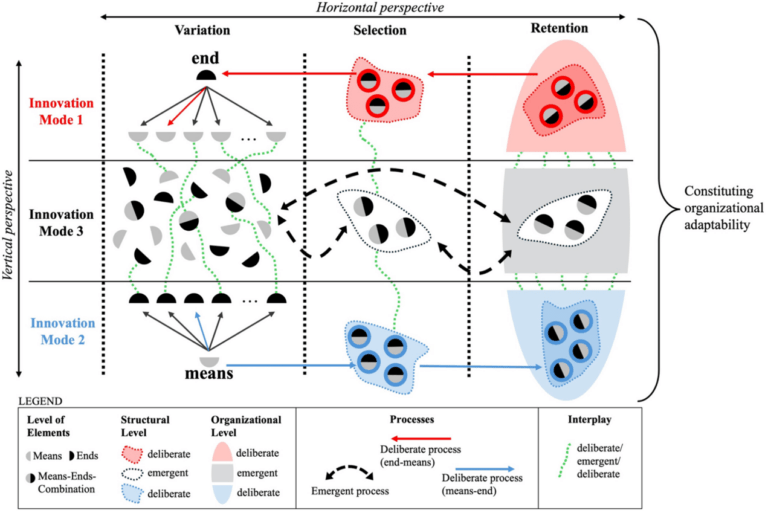
This article develops an evolutionary model that synthesizes emergent and deliberate innovation processes to explain how organizational adaptability is constituted. Existing research on “emergent” innovation processes tends to view these as diametrically opposed to “deliberate” action, applying each attribute with little nuance and relying on an under-complex understanding of the interplay between evolutionary mechanisms. We translate insights from Niklas Luhmann’s concept of adaptation processes and sociocultural theory of evolution into the organizational innovation management context to address these limitations. The resulting model systematically integrates distinct means–ends and end–means logics and identifies an intermediate “third” space where emergent dynamics prevail. Our model demonstrates how and why deliberate and emergent innovation processes are interdependent rather than mutually exclusive, jointly contributing to an organization’s ability to both adapt to and shape its environment. After unfolding the subtle interplay between deliberate and emergent innovation processes from three coherent perspectives, we derive three related propositions. These insights, we argue, advance the theoretical discussion and practical understanding of innovation management in increasingly complex and uncertain environments, thereby providing a foundation for future research on emergent innovation processes and adaptability.
A special thank you also goes to Tobias Röth for guiding the special issue process and providing us with valuable feedback and insights. We are also grateful for the constructive feedback from Dimo Dimov, Paula Jarzabkowski, and David Seidl, as well as from participants at the German Association for Business Research WK ORG 2024 and the PROS Symposium 2024.